
The Weight You Carry: A Survival Guide for Animal Shelter Leaders
Let's start with some numbers that probably won't surprise you, but should alarm everyone else.
The annual employee turnover rate at animal shelters is 33%. The national average across all industries is 3.3%. That means shelters lose staff at roughly ten times the rate of a typical workplace. And behind every one of those departures is a person who walked in caring deeply and walked out unable to carry it anymore.
If you're reading this as a shelter director, operations manager, or executive director — you already feel this. You've trained people who left within months. You've covered shifts because there was no one else. You've sat in your car after work wondering how much longer you can keep going.
This article is for you. Not the motivational poster version of leadership. The real version.
The Crisis Nobody Talks About Publicly
A 2024 study by Best Friends Animal Society found that 85% of shelter workers experience moderate to high levels of burnout. Even more alarming, nearly 91% scored high for secondary traumatic stress — the kind of psychological toll that comes from repeatedly witnessing animal suffering, making life-and-death decisions, and absorbing the emotional weight of an under-resourced system.
To put that in perspective, shelter workers experience burnout and secondary traumatic stress at levels comparable to — and in some cases exceeding — first responders like firefighters, police officers, and nurses. Except first responders have unions, public recognition, mental health mandates, and significantly higher pay.
Shelter workers have compassion. And that's often all they're given to work with.
The same study found that staff who reported high burnout scores were significantly more likely to leave. Those who said they were "somewhat likely" or "not likely" to stay scored an average burnout level of 31.5, compared to 25.1 for those planning to stay. The math is clear: burnout drives turnover, and turnover destabilizes everything — animal care, team morale, institutional knowledge, and your sanity as a leader.
Why "Just Push Through" Isn't Leadership
Here's where this gets personal. If you're a shelter leader, there's a good chance you got the job because you were the person who never said no. You stayed late. You covered shifts. You took on more than your share because the animals needed someone, and you were there.
That quality got you into leadership. It can also be the thing that destroys you in it.
The post-pandemic shelter landscape has made everything harder. Admissions have outpaced adoptions. Veterinary staffing shortages mean longer animal stays and higher medical costs. The cost of food, supplies, and basic operations has risen sharply. Donors are giving less as their own expenses grow. And eviction moratoriums expiring have led to more owner surrenders than many shelters can absorb.
You're being asked to do more with less, and the "more" involves life-and-death decisions for living beings. That's not a workload problem. That's a moral injury problem. And no amount of pizza parties or "self-care Fridays" is going to fix it.
What Actually Helps: Systems, Not Slogans
The research points to real, structural interventions — not motivational platitudes. Here's what the data shows works.
A pilot program documented in the Journal of Shelter Medicine found that a 10-week staff support group achieved a 64% increase in compassion satisfaction, a 64% decrease in burnout, and a 45% decrease in compassion fatigue among participants. The sample was small, but the results were significant. People need a space to process what they experience — not just once a year at a conference, but regularly, with colleagues who understand.
As a leader, that means creating those spaces. It doesn't require a budget. It requires permission — permission for your team to say "this is hard" without being seen as weak, and permission for yourself to say the same thing.
Beyond emotional support, here's what high-retention shelters are doing differently.
Cross-Training as a Retention Strategy. When people do the same emotionally draining tasks every single day, they burn out faster. Shelters that cross-train staff across departments — medical, behavior, adoption counseling, community outreach, social media, fundraising — report higher engagement and longer tenures. People stay when they're growing. When every shift feels identical, they start looking for the exit.
Including Staff in Decisions. One of the top stressors identified in a 2025 study was feeling powerless — watching decisions get made about animals and policies without having input. Leaders who involve their team in shelter improvements, protocol changes, and even difficult euthanasia decisions build ownership and loyalty. People don't just want to be told what to do. They want to be part of something meaningful.
Exit Interviews That Actually Lead to Change. When someone leaves, they'll tell you things your current team won't. Are they leaving because of pay? Burnout? A specific policy? A coworker? That feedback is valuable — but only if you act on it. If three people leave citing the same issue and nothing changes, the fourth person won't bother telling you.
Protecting Your Own Oxygen Mask
Here's the part no one writes for shelter leaders, so I'm going to say it plainly.
You cannot lead a team through burnout if you are burnt out yourself. And statistically, you probably are. The same 85% burnout rate applies to you. The same secondary traumatic stress applies to you. The difference is that when you're in charge, admitting it feels dangerous — like the whole operation will collapse if you show a crack.
It won't. What will cause collapse is you running at 20% capacity, making reactive decisions, snapping at staff, and slowly disconnecting from the mission that brought you here.
Taking your day off isn't selfish. Setting a boundary on weekend calls isn't abandonment. Telling your board "we need more resources or we need to reduce scope" isn't failure. It's the most responsible leadership you can practice.
Model the sustainability you want your team to practice. When you take care of yourself visibly, you give your team permission to do the same. When you don't, you're teaching them that self-sacrifice is the expectation — and that's a lesson that leads straight to turnover.
The Fundraising Burden Falls on You — And That's Okay
One of the underappreciated realities of shelter leadership is that you are, by default, your organization's chief fundraiser. No one can tell your shelter's story the way you can. You've held the animals that came in broken. You've watched your team work miracles with almost nothing. That authenticity is your greatest fundraising asset.
The data supports this. Monthly sustainer programs now account for a third of all animal care nonprofit revenue, with average monthly gifts around $30. That's accessible — but it requires consistent storytelling and relationship building. Former adopters convert to donors at higher rates than cold prospects. Your community already cares. They just need you to keep showing up and asking.
This isn't a distraction from your "real work." Fundraising IS the work. Without it, the kennels don't get cleaned, the vet doesn't get paid, and the team you fought to build doesn't have jobs. Reframe it not as begging, but as advocacy. You're the most informed, most passionate person in the room. Own that.
What About Your Staff Who Are Already on the Edge?
Watch for these signs — in your team and in yourself.
Emotional withdrawal. The person who used to cry over a difficult case and now feels nothing. That numbness isn't strength. It's a red flag.
Increased absenteeism or chronic lateness. This often isn't laziness — it's avoidance. Coming to work has become psychologically painful.
Cynicism about the mission. When someone who used to say "we're making a difference" starts saying "what's the point" — they need support, not a performance review.
Physical symptoms. Headaches, stomach issues, insomnia, getting sick more often. Compassion fatigue shows up in the body, not just the mind.
If you're seeing these signs, don't wait. Have a conversation. Not a formal one — a human one. "Hey, I've noticed you seem off lately. I care about you. What do you need?" Sometimes that's all it takes. Sometimes it leads to a referral for professional support. Either way, you showed up for them the same way you show up for the animals.
You're Not Failing. The System Is Underfunded.
If there's one thing I want you to take from this article, it's this: the overwhelm you feel is not a personal failure. It's the predictable result of an underfunded, emotionally demanding system that relies on the goodwill of people who care too much to walk away.
That doesn't mean you're powerless. Every small improvement — a better hiring process, a support group, a conversation you were brave enough to have, a boundary you finally set — compounds over time. You don't have to fix the entire animal welfare system. You just have to take care of your people, take care of yourself, and keep showing up.
The animals need you. Your team needs you. But they need the sustainable version of you — the one who's still here next year, and the year after that.
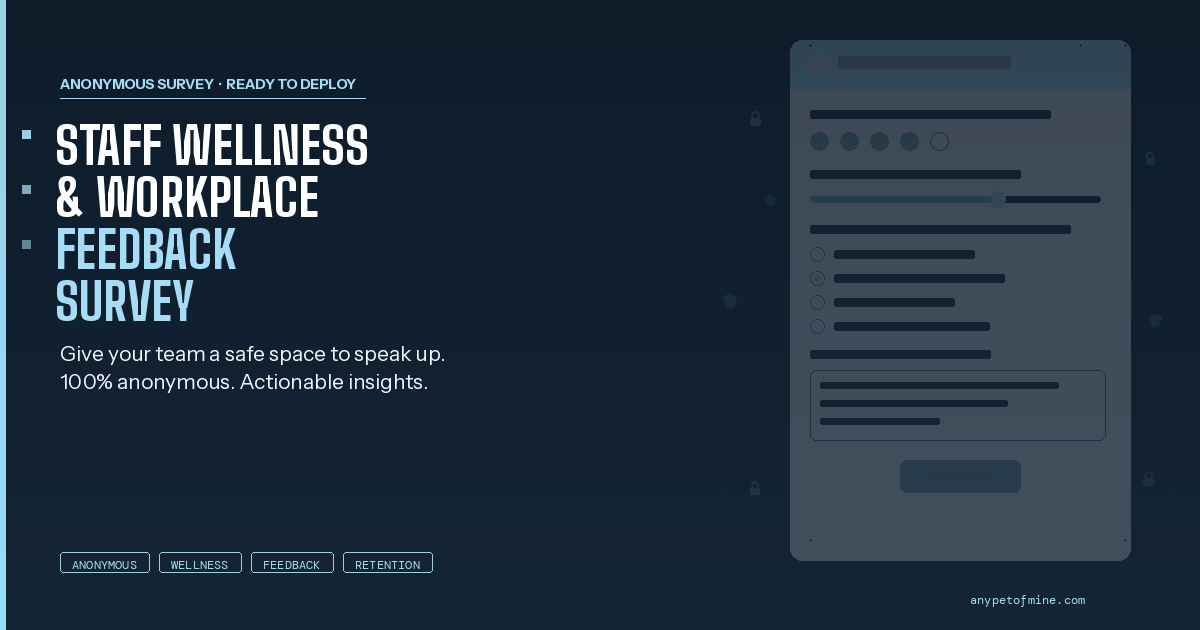
A printable, anonymous 6-page survey designed specifically for animal shelter and rescue staff. Covers daily work experience, emotional wellbeing and compassion fatigue, leadership and communication, growth and retention, and open feedback. Uses a simple 1-5 rating scale with space for written responses. Designed to be folded and placed in a collection box — no names, no tracking.
