
Balancing Roles: What Real Leadership Looks Like in an Animal Shelter
There's a unique kind of leadership required to run an animal shelter. It doesn't look like a corner office. It doesn't come with a suit and tie. On any given day, it looks like scrubbing kennels at 7am, comforting a grieving pet owner at noon, presenting to city council at 3pm, and staying late to cover a shift because someone called out.
If you're in a leadership position at a shelter or rescue — Executive Director, Shelter Manager, Operations Lead — you already know this. But it's worth talking about why this kind of leadership matters, and how to do it without losing yourself in the process.
Lead From the Kennel, Not Just the Office
A true leader doesn't just delegate — they demonstrate. The willingness to perform every task, from scooping litter to mopping floors to restraining a fearful dog for a vet check, builds something that no title ever can: trust.
When your staff sees you shoulder both the rewarding and the unglamorous work, something shifts. They stop seeing you as the person who gives orders and start seeing you as someone who gets it. That builds respect, loyalty, and a team culture where no one feels like any job is beneath them — because it's clearly not beneath you.
This doesn't mean you should be doing everyone's job all the time. It means showing up on the front lines often enough that your team knows you understand what their day actually looks like. Leadership is earned in the kennel, on the adoption floor, and in the intake room — not just in meetings.
You Are the Face and Voice of Your Shelter
Whether you asked for it or not, as the leader you are the most visible representative of your organization. You're the one speaking at city council meetings, meeting with potential donors, doing media interviews, and shaking hands at community events. You are both the face and the voice of your shelter to the public.
And here's the thing — no one can tell the story of your organization better than you. You're the person who lives it every single day. You've held the animals that came in scared and broken. You've watched your team pull off miracles with barely enough resources. That authenticity makes you the most effective ambassador your organization has when it comes to fundraising, partnerships, and community outreach.
Lean into that. Your passion isn't a weakness in professional settings — it's your greatest asset. Donors and partners don't write checks for polished presentations. They invest in people who clearly care.
Immersion Makes You a Better Leader
There's a practical reason to stay involved in daily operations beyond morale. When you're immersed in the work, you see things that reports and meetings will never show you. You notice which staff member has a natural gift with fearful animals. You see where a process breaks down every single time. You catch the early signs of burnout before someone hands in their resignation.
That firsthand observation lets you assign roles more strategically, build teams based on real-world strengths, and address problems before they become crises. Leaders who manage from a distance make decisions based on assumptions. Leaders who show up make decisions based on what's actually happening.
Participating in various roles also sharpens your understanding of what makes each position vital. You'll write better job descriptions, provide better training, and support your staff in ways that actually matter to them — because you've walked in their shoes.
The Hardest Balance: Doing Everything Without Doing Too Much
Here's where it gets tricky. The same quality that makes shelter leaders great — the willingness to do whatever it takes — can also be the thing that breaks them. You can't scoop every kennel, attend every meeting, write every grant, and cover every open shift forever.
The goal isn't to do everything. It's to show your team that you're willing to do anything, while building a structure where you don't have to. That means hiring well, training intentionally, delegating with trust, and letting go of the belief that no one can do it as well as you. They might do it differently. That's okay.
Your shelter needs you healthy, clear-headed, and present for the long haul — not burnt out and running on caffeine and guilt. Model the sustainability you want your staff to practice. Take your days off. Ask for help. It's not weakness — it's leadership.
The Bottom Line
The best shelter leaders aren't the ones with the fanciest titles or the biggest budgets. They're the ones who show up, get their hands dirty, tell their shelter's story with conviction, and build a team that believes in the mission because their leader clearly does too.
If that sounds like you — even on the days when you're exhausted and wondering if it's all worth it — keep going. Your team is watching, your animals need you, and your community is better because of the work you're doing.
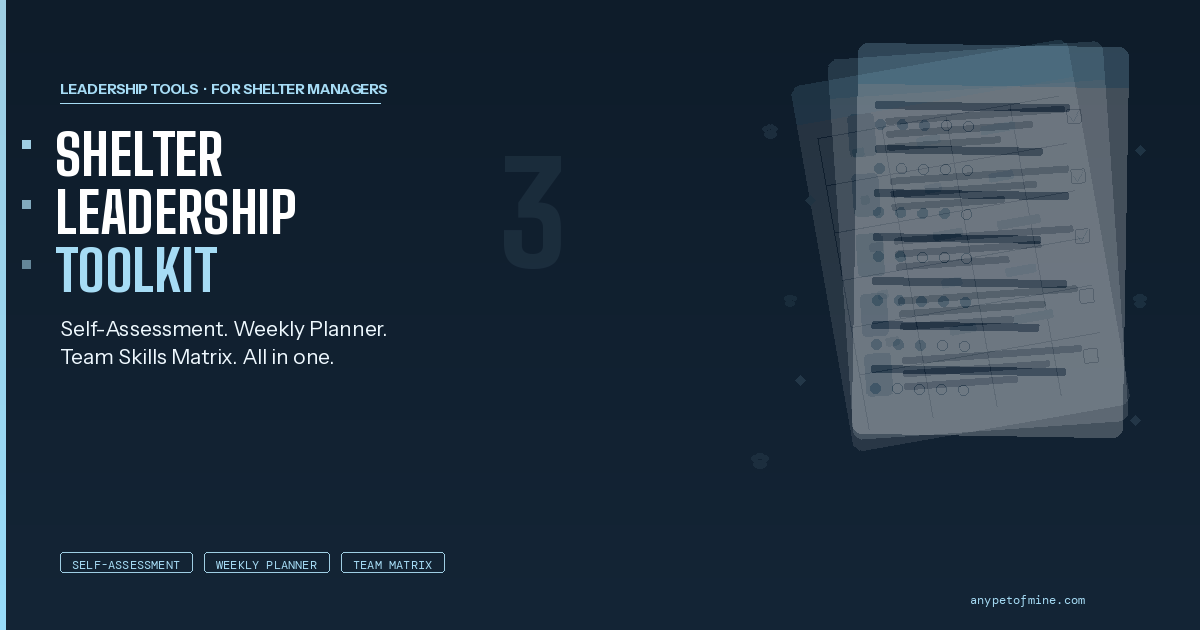
A 4-tab interactive spreadsheet built for shelter directors and managers. Includes a monthly leadership self-assessment scorecard (auto-scoring), a weekly planner to balance kennel time with meetings and fundraising, and a team strengths matrix to track staff development, compassion fatigue risk, and skills gaps. Fill-in-the-blank format — just open and start using.
